
How to Build Your First Skateboard (Without Overthinking It)
If you’ve ever stood in a skate shop staring at a wall of decks, trucks, wheels and mysterious little metal rings thinking “I just want a skateboard, why does this feel like building a spaceship?” - you’re not alone. Building your first skateboard can look complicated, but the reality is much simpler: a skateboard is basically a plank of wood with some wheels attached. The magic is in choosing the parts that feel right for how you want to ride. Once you understand the basics, putting together a setup becomes part of the fun rather than some kind of hardware exam.
Decks: The Bit You Actually Stand On
At the heart of every skateboard is the deck. This is the bit you actually stand on, so it’s worth taking a moment to think about size. Most modern street boards sit somewhere between 8 and 8.5 inches wide. If you’ve got smaller feet or want something that flips easily for tricks, something closer to 8 or 8.125 will feel quick and nimble. If you like a bit more stability under your feet, especially for cruising, transition or bowls, an 8.25 or 8.5 can feel more planted.
A lot of riders settle somewhere in the middle and never think about it again. The truth is that after a few sessions you’ll adapt to whatever you’re riding. Brands like Toy Machine and Powell Peralta produce decks in every shape, width and graphic imaginable, so half the decision comes down to what makes you want to grab the board and head outside. If the graphic makes you smile every time you look at it, that’s usually a good sign you’ve picked the right one.
Trucks: The Turning, Grinding, Metal Bits
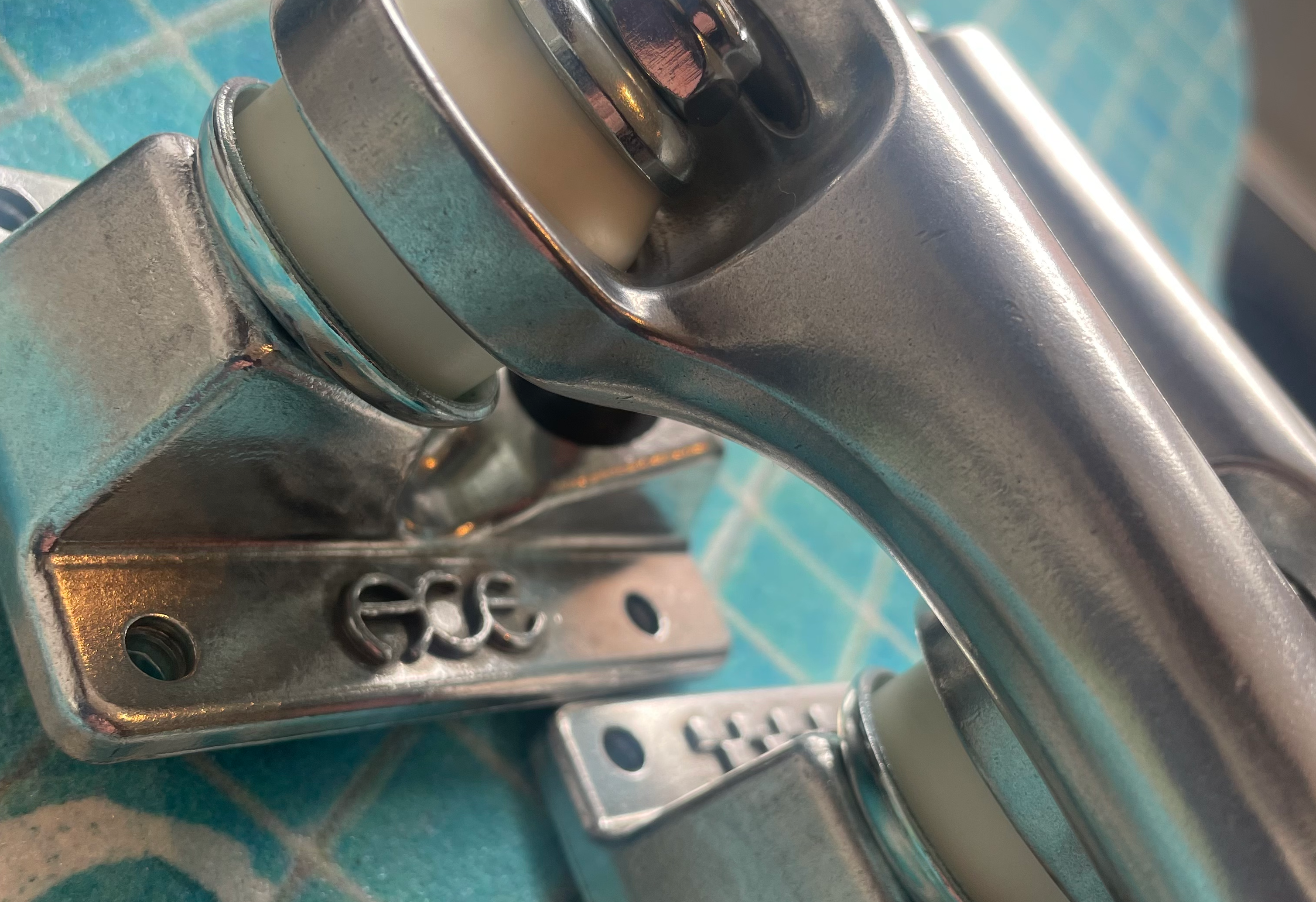
Next up are trucks, the metal components that connect the wheels to the deck and let you turn. They might not be as visually exciting as a deck graphic, but they have a huge impact on how your skateboard feels when you ride it. Some trucks feel tight and stable, while others carve smoothly and feel more surfy under your feet.
A lot of skaters swear by Ace Trucks because they turn beautifully straight out of the box and feel lively whether you’re cruising down the street or carving a bowl. The main thing to pay attention to here is width. Your trucks should roughly match the width of your deck so the wheels sit neatly underneath it rather than sticking out like a pair of training wheels. Once they’re bolted on and dialled in, trucks tend to last a long time, so it’s worth choosing a pair you’ll be happy riding for a while.
Wheels: How Your Board Meets the Ground
Wheels are where things can get surprisingly nerdy if you let them. There are endless options in different sizes and hardness levels, but for a first setup you don’t need to get lost in the technical details.
Smaller wheels accelerate quickly and are great for street skating and technical tricks, while slightly larger wheels roll faster and handle rough ground a bit better. Most street setups land somewhere in the low 50mm range, which keeps the board feeling responsive while still rolling smoothly. Harder wheels are ideal for smooth skateparks where you want speed and slide, while slightly softer wheels can make rough streets feel a lot less hostile. For most new riders, a good all-round set will work perfectly while you figure out where and how you like to skate.
Bearings: The Tiny Things That Make You Roll
Inside each wheel sits a set of bearings, and these small metal components are what allow your skateboard to roll smoothly instead of sounding like a shopping trolley with a broken wheel. Bearings might be small, but they make a big difference to how fast and smoothly your board moves.
There are plenty of options out there, but the skate world has quietly agreed on a classic favourite over the years. Bones bearings (particularly the famous Reds) have been a go-to choice for decades because they’re fast, reliable and reasonably priced. You can spend much more on high-end bearings if you really want to, but for most riders a solid set of Bones will keep things rolling perfectly happily.
Grip Tape: The Sandpaper That Keeps You On
Grip tape is the rough, sandpaper-like sheet that sits on top of the deck and keeps your shoes locked in place while you ride. It might not seem very glamorous, but without it your feet would slide straight off the board the moment you tried to turn or pop a trick.
Applying grip tape for the first time is one of those small skateboarding rituals that feels oddly satisfying. You peel off the backing, carefully lay it down across the deck, smooth out the bubbles and trim the edges with a blade. Suddenly your plank of wood starts to look like a proper skateboard.
Putting It All Together
Once you’ve got your deck, trucks, wheels, bearings and grip tape sorted, the rest is simply a matter of bolting everything together. The process might only take half an hour, but it gives you something that feels genuinely yours. A board you built yourself always feels different to something pulled straight from a box.
At Wobble we’re big believers that your first skateboard setup shouldn’t feel intimidating. It should feel exciting - like the start of a long series of slightly questionable decisions involving curbs, car parks and late evening sessions with your mates. Pick the parts that make you want to ride, put them together, and get outside. The best skateboard setup in the world is still useless if it never leaves the house.